


Marine environments are among the toughest conditions for steel, vessels, offshore structures, and equipment. Constant exposure to seawater, moisture, salt, sunlight, changing temperatures, and biological organisms can gradually damage unprotected surfaces and significantly increase maintenance costs.
This is why choosing the right marine and antifouling coatings is an important part of protecting ships, boats, marine structures, and equipment operating in or near seawater.
Marine coatings are designed to protect surfaces against harsh marine conditions, while antifouling coatings have a more specific purpose: helping control the attachment and growth of marine organisms on submerged surfaces.
Choosing the right product, however, is not simply a matter of buying a can labeled "marine paint." Different areas of a vessel or marine structure face different conditions. A coating suitable for an exposed steel structure may not be suitable for a permanently submerged hull.
At Stock Sanat, we supply BAJAK marine and industrial coatings for both regular and wholesale orders. Customers can purchase products according to their project requirements, whether they need a smaller quantity for maintenance or larger volumes for industrial and marine projects.
In this guide, we will look at marine coatings, antifouling paints, their applications, differences, prices, purchasing considerations, and the factors you should check before choosing a coating system.
What Are Marine Coatings?
Marine coatings are protective coating systems developed for surfaces exposed to marine environments.
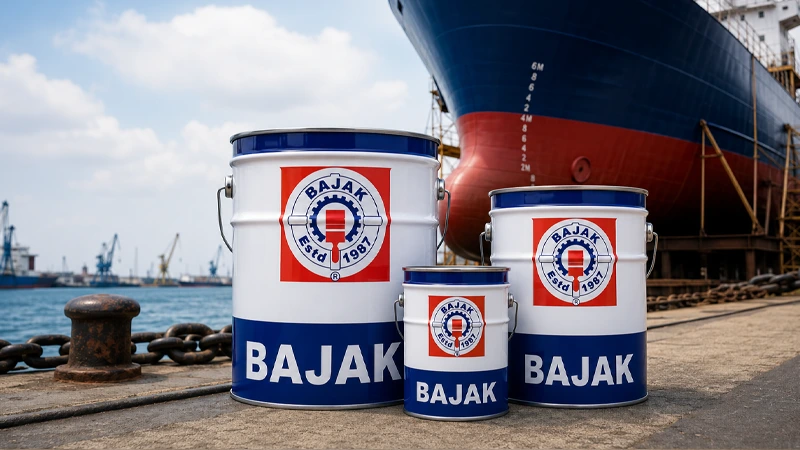
These coatings are commonly used on vessels, boats, marine equipment, steel structures, and other surfaces that may experience seawater, salt spray, high humidity, or severe weather conditions.
The term "marine coating" does not refer to one specific type of paint. Instead, it covers a range of primers, intermediate coats, topcoats, antifouling coatings, and other specialized products.
A complete marine coating system may include several layers.
For example:
Steel Surface → Marine Primer → Intermediate Coat → Protective Topcoat
For submerged sections, the system may be different and can include an antifouling layer where required.
Each layer has its own purpose. The primer helps create the foundation of the coating system, intermediate coats provide additional protection and film thickness, and the final coat is selected according to the environment in which the surface will operate.
This is why marine coating selection should always be based on the entire coating system, not just the final paint.
What Is Antifouling Paint?
Antifouling paint is a specialized marine coating intended for surfaces that remain submerged in water, particularly vessel hulls.
When a vessel stays in water, marine organisms can begin to attach to submerged surfaces. Over time, this biological growth—known as biofouling—may include algae and other marine organisms.
Fouling can affect the condition and performance of a vessel's underwater surfaces. A heavily fouled hull may create additional drag, which can influence vessel efficiency.
Antifouling coatings are therefore used as part of underwater coating systems to help control biological fouling.
It is important to understand that antifouling paint is not simply another decorative marine topcoat. Its function, formulation, application requirements, and service conditions can be different from conventional marine coatings.
For this reason, the antifouling product should be selected according to the vessel, operating conditions, coating compatibility, and technical specifications of the product.
Marine Paint vs. Antifouling Paint: What Is the Difference?
Marine paint and antifouling paint are sometimes treated as interchangeable terms, but they do not necessarily mean the same thing.
Marine coating is a broad term covering coating products developed for marine environments.
Antifouling coating, on the other hand, is a specific type of marine coating designed primarily for submerged surfaces where biological fouling is a concern.
For example, different sections of a vessel may require different coating systems.
The underwater hull may require an antifouling system, while areas above the waterline may use another marine protective coating system.
Decks, tanks, machinery, steel structures, and other components may also require coatings designed specifically for their operating conditions.
Therefore, instead of asking:
"What is the best marine paint?"
A more useful question is:
"Which marine coating system is suitable for this specific surface and operating environment?"
The answer depends on the location of the surface, exposure conditions, substrate, existing coating, and maintenance requirements.
Why Are Marine Coatings Important?
Marine structures operate in conditions that can be highly aggressive toward unprotected steel.
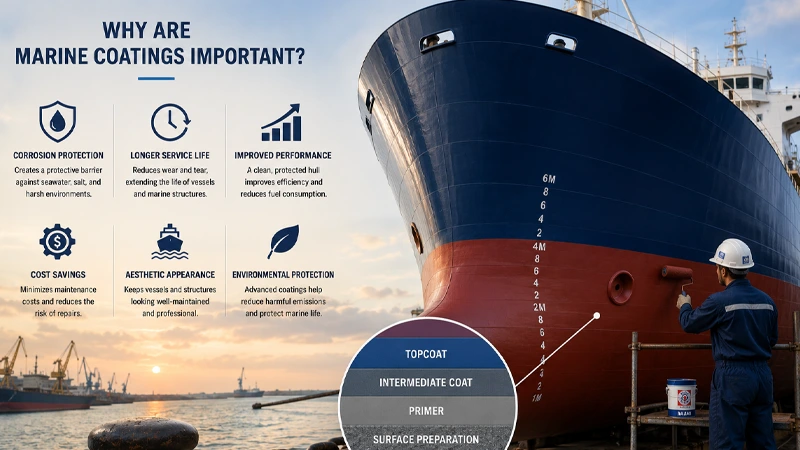
Saltwater, humidity, salt spray, sunlight, temperature changes, mechanical wear, and continuous exposure can all contribute to deterioration.
A properly selected and correctly applied coating system provides a protective barrier between the substrate and the surrounding environment.
This can help reduce corrosion, extend maintenance intervals, and improve the service life of protected surfaces.
The quality of the paint itself is only one part of the equation.
The performance of a marine coating system also depends on:
- Surface preparation
- Primer selection
- Compatibility between coating layers
- Required dry film thickness
- Application conditions
- Mixing ratio
- Recoat intervals
- Curing conditions
- Operating environment
Ignoring any of these factors can reduce the expected performance of the coating system.
Types of Marine Coatings
Marine coating systems can contain several different types of products. The exact system depends on the vessel, surface, exposure zone, and technical requirements of the project.
Marine Primers
Primers form the first protective layer of many marine coating systems.
They are applied to properly prepared surfaces and provide the foundation for subsequent coating layers.
Selecting the correct primer is important because the performance of the intermediate and finishing coats can depend on the condition and compatibility of the primer underneath.
Epoxy Marine Coatings
Epoxy coatings are widely used in industrial and marine coating systems.
Depending on their formulation, they may provide good adhesion, film build, and protective properties. They are commonly found in primers and intermediate coating systems.
However, the exact use of an epoxy product should always be determined according to its technical data sheet and the required coating specification.
Polyurethane Topcoats
Polyurethane coatings are commonly considered where a durable and attractive finishing coat is required, particularly for surfaces exposed to weather and sunlight.
In some marine coating systems, epoxy layers provide the underlying protection while polyurethane is used as the finishing coat.
Again, the exact combination depends on the project specification.
Antifouling Coatings
Antifouling coatings are used for underwater surfaces where marine growth is a concern.
They should be selected according to the vessel, service conditions, existing coating system, and manufacturer's recommendations.
Specialized Marine Coatings
Some marine environments require specialized coating solutions.
Tanks, decks, underwater structures, machinery, and other components may each have different requirements. A coating that performs well in one area should not automatically be assumed to work in another.
Where Are Marine and Antifouling Coatings Used?
Marine coatings have a wide range of applications across marine, shipping, and industrial environments.
Ship Hulls
Ship hulls are one of the most obvious applications.
Different areas of a hull may experience different levels and types of exposure. Submerged sections remain in contact with water, while areas above the waterline are exposed to salt spray, sunlight, and changing weather.
As a result, different sections may require different coating systems.
Boats and Marine Vessels
Commercial boats, service vessels, and other marine craft also require appropriate protective coatings.
The correct system depends on vessel construction, operation, water conditions, and maintenance schedule.
Offshore Structures
Offshore steel structures operate in demanding environments where corrosion protection is critical.
The selected coating system must take into account the exact exposure zone and project specification.
Marine Equipment
Marine equipment exposed to humidity, salt spray, or seawater may also require specialized protective coatings.
Ports and Coastal Structures
Steel components and equipment in ports, docks, and coastal facilities can be exposed to high humidity and salt contamination even when they are not permanently submerged.
This makes proper surface protection an important part of maintenance planning.
Buying Marine and Antifouling Coatings
When buying marine and antifouling coatings, the first step should be identifying exactly where and how the product will be used.
Buying marine paint based only on product name or price can result in choosing a coating that does not match the operating environment.
Before ordering, consider the following questions:
- What is the substrate?
- Is the surface steel or another material?
- Will the surface be permanently submerged?
- Is it above or below the waterline?
- Is the surface exposed to direct sunlight?
- What coating is currently on the surface?
- Is a primer required?
- Is an intermediate coat required?
- What is the total surface area?
- What dry film thickness is specified?
- What application method will be used?
- Is this a new coating project or maintenance work?
These details make it easier to identify the appropriate coating system.
At Stock Sanat, customers can purchase BAJAK marine and antifouling coatings for regular requirements as well as larger project orders.
If you are unsure which product is suitable, determine the application area, surface condition, existing coating system, and approximate required quantity before ordering.
Need BAJAK marine or antifouling coatings for your project? Contact Stock Sanat with your application details and required quantity to check the appropriate product and current purchasing conditions.
Price of Marine and Antifouling Coatings
The price of marine and antifouling coatings can vary considerably because marine paint is not a single standardized product.
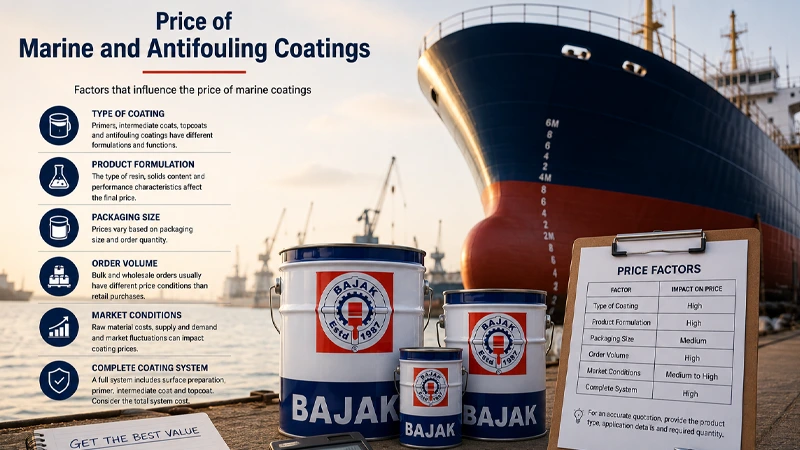
Different formulations are designed for different applications, and their technical specifications can affect the final price.
Type of Coating
A marine primer, epoxy intermediate coat, polyurethane topcoat, and antifouling coating are different products with different functions.
Their prices should therefore not be expected to be identical.
Product Formulation
Coatings with different resin systems, solids content, application characteristics, and performance requirements may have different prices.
Packaging Size
Packaging and order quantity can affect the final purchasing cost.
For project orders, it is better to calculate the approximate total requirement before requesting a quotation.
Order Volume
The price conditions for a small regular order may differ from a large wholesale or project purchase.
If your project requires a significant quantity of coating, request a quotation based on the total estimated volume.
Market Conditions
Industrial coating prices can also be influenced by raw material and market conditions. For this reason, fixed prices may not always remain accurate over long periods.
Complete Coating System
When calculating the cost of marine coating, do not consider only the final coat.
A complete system may require:
Surface Preparation + Primer + Intermediate Coat + Topcoat/Antifouling
The actual project cost therefore depends on the complete system.
Price per Can Is Not the Whole Cost
Comparing two products only by their package price can be misleading.
Coverage, required film thickness, number of coats, surface preparation, application loss, and maintenance intervals can all affect the real cost of the coating project.
A lower purchase price does not necessarily mean a lower overall project cost.
For an accurate marine and antifouling coating price, identify the required product, approximate quantity, and project application first.
For current BAJAK marine coating prices, contact Stock Sanat with the product type and quantity you require. Wholesale and regular orders are available.
Sale of Marine and Antifouling Coatings
When looking for the sale of marine and antifouling coatings, it is important to choose a supplier that understands the difference between general industrial paint and products intended for marine environments.
Marine coating selection is application-specific.
A product used successfully on an exposed steel structure may not be suitable for a submerged hull. Likewise, an antifouling product intended for underwater service should not automatically be treated as a general-purpose marine topcoat.
At Stock Sanat, we supply BAJAK marine and industrial coating products for different purchasing requirements.
Customers can order regular quantities for maintenance or smaller applications, while contractors, industrial buyers, and larger projects can request wholesale quantities.
Before ordering, having the following information ready can make the purchasing process easier:
- Product or coating type
- Application area
- Surface material
- Existing coating
- Approximate surface area
- Required quantity
- Project conditions
This information is especially useful for larger orders where selecting the correct product and estimating the required quantity are important.
Looking for BAJAK marine and antifouling coatings? Contact Stock Sanat to check product availability, purchasing conditions, and pricing for your required quantity.
Wholesale Purchase of Marine and Antifouling Coatings
The wholesale purchase of marine and antifouling coatings is particularly relevant to shipyards, contractors, industrial companies, maintenance teams, marine service providers, and large-scale projects.
Wholesale purchasing requires more planning than simply ordering a larger number of cans.
The first step is estimating the coating requirement accurately.
This calculation generally depends on:
- Total surface area
- Theoretical coverage of the coating
- Required dry film thickness
- Number of coats
- Application method
- Expected application loss
- Surface condition
Technical data from the specific product should be used for accurate calculations.
For example, assuming the same coverage rate for every marine coating can lead to incorrect estimates because different products can have different solids content, recommended thicknesses, and application requirements.
Why Calculate Quantity Before a Wholesale Order?
Ordering too little coating can interrupt the application process and create delays.
Ordering significantly more than necessary can increase storage requirements and project costs.
For larger marine projects, it is therefore better to estimate the complete coating system rather than calculating only the topcoat.
At Stock Sanat, BAJAK marine and antifouling coatings can be supplied for both wholesale and regular purchases.
For wholesale inquiries, provide the product name if known, application, and approximate quantity required. This helps make the quotation process more relevant to the actual project.
Planning a large marine coating project? Send Stock Sanat your required coating type and estimated quantity to request wholesale purchasing information for BAJAK products.
How to Choose the Right Antifouling Paint
Choosing an antifouling coating requires more than selecting a product labeled "antifouling."
Start by understanding the vessel and its operating conditions.
Consider whether the vessel remains in water continuously or only for certain periods. The type of water, vessel operation, existing coating, and maintenance schedule can all influence product selection.
Compatibility is another important consideration.
If an existing coating system is already present, the new coating should be evaluated for compatibility. Applying an incompatible product over an old system may lead to coating defects or premature failure.
The product's technical data sheet should provide important information about recommended use, surface preparation, application, film thickness, drying, and recoating.
For professional or large-scale applications, the coating specification should always be followed.
How to Apply Marine and Antifouling Coatings
Correct application is essential for coating performance.
Even a high-quality marine coating may perform poorly if the surface is contaminated or the coating is applied outside its recommended conditions.
Surface Preparation
Surface preparation is one of the most important stages.
The surface should be free from contaminants that could interfere with adhesion, such as oil, grease, dirt, loose material, and other unwanted deposits.
For steel surfaces, the required preparation standard depends on the coating system and project specification.
Check Existing Coatings
For maintenance projects, inspect the existing coating before applying a new product.
Loose or damaged areas may need to be removed or repaired. Compatibility between the existing coating and the new layer should also be confirmed.
Mix According to the Technical Data Sheet
For multi-component coatings, use the specified mixing ratio.
Changing the ratio can affect curing and final performance.
Observe Pot Life
Some multi-component coatings have a limited usable period after mixing.
Do not assume mixed paint remains usable indefinitely.
Apply the Correct Film Thickness
Applying too little coating may reduce protection.
Applying too much can also create application and curing problems, depending on the product.
Follow the recommended wet and dry film thickness in the technical documentation.
Respect Recoat Intervals
The next coat should be applied within the recommended recoat conditions.
Applying too early or too late may affect intercoat adhesion.
Consider Weather Conditions
Temperature, surface temperature, humidity, ventilation, and moisture can influence coating application.
For marine work, environmental conditions should be checked carefully before and during application.
Surface Preparation for Marine Coatings
Surface preparation deserves special attention because many coating problems begin underneath the visible paint film.
A coating cannot compensate for a poorly prepared surface.
Rust, salts, grease, dust, old loose paint, and other contamination can interfere with adhesion and coating performance.
The exact preparation method depends on the substrate, condition of the surface, coating specification, and whether the project involves new construction or maintenance.
In professional projects, surface preparation standards may be defined in the coating specification.
Before applying any BAJAK coating, refer to the relevant product information and project requirements.
Marine Coating Systems for Steel
Steel is widely used in marine environments, but it requires appropriate protection against corrosion.
A marine coating system for steel may consist of multiple layers rather than one thick coat.
A simplified system could include:
Prepared Steel → Primer → Epoxy Intermediate Coat → Suitable Finish
For underwater sections, a compatible antifouling system may be included depending on the application.
Each layer has a specific role.
The primer provides the initial foundation, intermediate coats help build protective film thickness, and the final coating provides properties appropriate for the exposure environment.
The correct system can differ significantly depending on whether the steel is located:
- Above the waterline
- In splash zones
- Permanently submerged
- Inside a vessel
- In tanks
- On decks
- In coastal industrial environments
This is why marine coating systems should be selected according to the actual service area.
Antifouling Paint for Ship Hulls
The underwater hull is one of the most important areas where antifouling coatings are used.
When a hull remains submerged, marine organisms can attach to its surface over time. This fouling changes the surface condition and can increase hydrodynamic resistance.
Antifouling coatings form part of the vessel's underwater coating system to help manage this issue.
However, antifouling should not be viewed as an isolated layer.
The underlying coating system needs to provide an appropriate foundation and should be compatible with the antifouling product.
During maintenance, the condition of the existing underwater coating should also be inspected before recoating.
For these reasons, selecting antifouling paint for ship hulls should be based on technical requirements rather than color or package price alone.
What to Consider Before Buying Marine Coatings
Before purchasing marine or antifouling coatings, check these six points carefully.
1. Identify the Surface
Determine whether the substrate is steel, previously coated steel, or another material.
The substrate affects surface preparation and coating selection.
2. Identify the Exposure Zone
A submerged hull, deck, exterior steel structure, and interior equipment do not operate under the same conditions.
Knowing where the coating will be used is essential.
3. Review the Complete Coating System
Do not select only the finishing coat.
Check whether the project requires a primer, intermediate coating, and final protective layer.
4. Read the Technical Data Sheet
The technical data sheet provides important information about mixing, film thickness, drying, recoating, application, and recommended use.
5. Estimate the Required Quantity
Calculate the approximate quantity before purchasing, particularly for wholesale or project orders.
6. Compare More Than Price
Price matters, but it should not be the only consideration.
Coverage, required film thickness, number of coats, application requirements, and expected maintenance can all affect the overall cost.
Common Mistakes When Buying Antifouling Paint
One common mistake is buying antifouling paint based only on price.
A cheaper product is not necessarily more economical if it does not match the vessel's requirements or coating system.
Another mistake is ignoring the existing coating.
Compatibility should be considered before applying a new antifouling layer over an old coating.
Poor surface preparation is another frequent problem. Applying new paint over contamination, loose coating, or an unsuitable surface can compromise the entire system.
Buyers may also underestimate the required quantity because they calculate only the surface area and ignore the required number of coats, film thickness, or application loss.
Finally, using a general marine coating where a specialized antifouling product is required—or treating antifouling as a general-purpose paint—can lead to incorrect product selection.
Why Choose BAJAK Marine Coatings from Stock Sanat?
For marine projects, having access to the required coating in the appropriate quantity can simplify purchasing and project planning.
Stock Sanat supplies BAJAK marine and industrial coatings for customers with different requirements.
You can purchase BAJAK products for regular maintenance needs as well as larger industrial and marine projects.
For wholesale requirements, customers can provide the approximate quantity and application details when requesting a quotation.
Our focus is not simply on selling a can of paint. The goal is to help customers identify the product category that matches their application before placing an order.
If you already know the exact BAJAK product you need, you can request pricing based on the required quantity.
If you are still selecting a coating, provide information about the surface, environment, existing system, and project requirements.
Contact Stock Sanat for BAJAK marine and antifouling coating availability, current pricing, and regular or wholesale purchasing inquiries.
Frequently Asked Questions About Marine and Antifouling Coatings
What is antifouling paint used for?
Antifouling paint is primarily used as part of coating systems for submerged marine surfaces, particularly vessel hulls, where biological fouling needs to be controlled.
Is antifouling paint the same as marine paint?
Not exactly. Marine paint is a broad category of coatings intended for marine environments. Antifouling is a specialized type of marine coating designed for submerged surfaces where marine growth is a concern.
Can antifouling paint be applied directly to steel?
The required coating system depends on the specific product, surface condition, and project specification. In many cases, appropriate surface preparation and underlying protective coatings are required before the antifouling layer is applied.
How much does marine antifouling paint cost?
The price depends on product type, formulation, packaging, order quantity, and market conditions. For an accurate quotation, specify the product and approximate quantity required.
Can I buy BAJAK antifouling coatings wholesale?
Yes. Stock Sanat supplies BAJAK marine and industrial coatings for both regular and wholesale orders. For larger purchases, provide the approximate quantity and application when requesting pricing.
How do I calculate how much marine paint I need?
You need the total surface area, coating coverage, required dry film thickness, number of coats, and an allowance for application loss. Use the technical data of the specific product for a more accurate calculation.
What is the best marine coating for steel?
There is no single coating that is best for every steel surface. The correct system depends on exposure conditions, surface preparation, location on the vessel or structure, and project requirements.
Does a ship need both marine paint and antifouling?
Different parts of a vessel may require different coating systems. Underwater sections may require antifouling as part of the system, while above-water areas can use other protective marine coatings.
Why is surface preparation important before applying marine paint?
Coating adhesion and performance depend heavily on the condition of the substrate. Contamination, loose paint, corrosion, or other surface defects can reduce the effectiveness of the coating system.
Where can I buy BAJAK marine and antifouling coatings?
BAJAK marine and industrial coating products are available through Stock Sanat for regular, wholesale, and project orders. Contact us with the coating type and quantity you require to check availability and current purchasing conditions.
Buy BAJAK Marine and Antifouling Coatings from Stock Sanat
Marine environments demand more from a coating than ordinary conditions.
Seawater, humidity, salt, sunlight, weather, and biological fouling can all affect vessels and marine structures. Choosing the right coating system is therefore an important part of protecting surfaces and planning long-term maintenance.
Marine primers, epoxy coatings, polyurethane topcoats, and antifouling products each serve different purposes. The correct combination depends on the substrate and service environment.
Before purchasing, identify the surface, exposure zone, existing coating, required system, and approximate quantity.
At Stock Sanat, we supply BAJAK marine and antifouling coatings for both regular and wholesale orders. Whether you need coatings for maintenance work or a larger marine project, you can request products according to your required volume.
Looking for BAJAK marine and antifouling coatings? Contact Stock Sanat to check current prices, product availability, and purchasing conditions for regular or wholesale orders.