
Stock Sanat Specialized Magazine


Buying or specifying a coating for a ship, a boat or an offshore structure means meeting a stack of rules. Owners, class societies and inspectors all point to marine paint standards, but each one covers a different part of the job.
This guide explains the two names you will see most often: ISO 12944 and the IMO PSPC for ballast tanks. You will learn what each requires, how they differ and how to turn them into a specification you can check. It is written for shipyards, boat builders, contractors and industrial buyers.
Table of Contents
Why Marine Paint Standards Matter
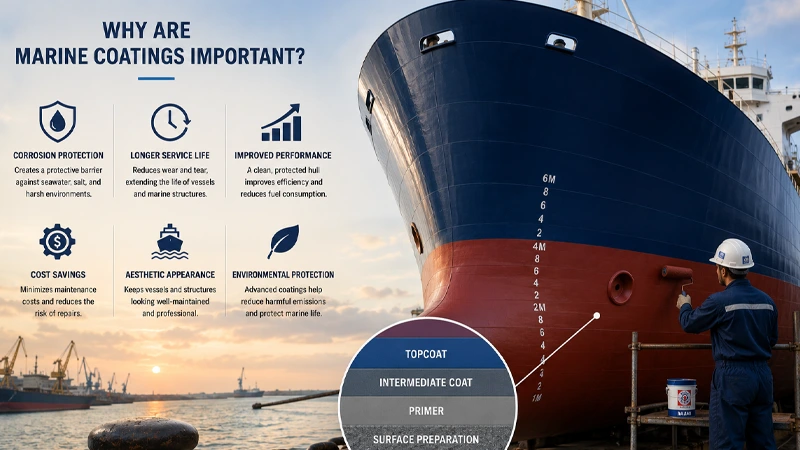
Steel in a marine setting faces salt, constant moisture, sunlight, abrasion and, in tanks, long periods of immersion. A coating that looks fine on day one can fail early if it was applied over poor surface preparation or at the wrong thickness.
Marine paint standards turn those risks into measurable limits. They define the environment, the surface quality, the paint system, the film thickness and the way work is inspected. Without them, a quote that says “two coats of epoxy” tells you very little.
Key point: A standard does not make a paint good. It sets the test and the process. The coating, the applicator and the inspection record still have to prove compliance.
For a broader look at product families, see our marine paint buying guide and the overview of types of tank coatings.
How Marine Paint Standards Are Organised
There is no single rulebook. Marine paint standards come from three levels, and a project often uses all of them.
| Level | Examples | Who sets or cites it |
|---|---|---|
| International technical standards | ISO 12944, ISO 8501-1, ISO 8503, ISO 19840 | Paint makers, designers, project specifications |
| Mandatory maritime rules | IMO PSPC (MSC.215(82)), IMO AFS Convention | Flag states, class societies, SOLAS and IMO regulations |
| Owner and class requirements | Class society rules, owner coating specifications, NORSOK M-501 for offshore | Shipowners, offshore operators, classification societies |
Always read the contract first. It states which marine paint standards are mandatory and which edition applies. Editions change, so verify each requirement against the current text before you order or apply paint.
ISO 12944: Corrosion Protection of Steel Structures
The full title is Paints and varnishes: Corrosion protection of steel structures by protective paint systems. It is the most widely cited of the marine paint standards for protective coatings. It is not limited to ships. Bridges, tanks, plants and offshore steel all use it.
The Parts of ISO 12944
The current series has several parts. Each one answers a different question in the coating process.
- Part 1: general introduction, terms and the durability ranges.
- Part 2: classification of environments, including corrosivity categories.
- Part 3: design considerations, such as edges, welds and access.
- Part 4: types of surface and surface preparation.
- Part 5: protective paint systems.
- Part 6: laboratory performance test methods.
- Part 7: execution and supervision of paint work.
- Part 8: development of specifications for new work and maintenance.
- Part 9: paint systems and test methods for offshore and related structures.
Corrosivity Categories C1 to CX
Part 2 ranks atmospheres by how fast they corrode unprotected carbon steel. The values below are the typical first-year thickness loss ranges. Check the exact limits in the standard before you rely on them.
| Category | Corrosivity | Steel loss, first year (approx.) | Typical marine example |
|---|---|---|---|
| C1 | Very low | up to 1.3 µm | Heated, clean interior spaces |
| C2 | Low | 1.3 to 25 µm | Dry, low-pollution rural air |
| C3 | Medium | 25 to 50 µm | Inland coastal fringe with moderate pollution |
| C4 | High | 50 to 80 µm | Industrial and coastal areas, boat yards |
| C5 | Very high | 80 to 200 µm | Coastal and offshore areas, ship topsides |
| CX | Extreme | 200 to 700 µm | Offshore splash zones, very aggressive industrial air |
Immersion Categories Im1 to Im4
Surfaces that sit in water use a separate set of categories in these marine paint standards. This matters for hulls, tanks and pilings.
- Im1: fresh water.
- Im2: sea or brackish water.
- Im3: soil.
- Im4: sea or brackish water with cathodic protection.
Durability Classes
Part 1 defines four durability ranges. They describe how long a coating is expected to last before the first major maintenance.
| Durability | Code | Expected time to first major maintenance |
|---|---|---|
| Low | L | Up to 7 years |
| Medium | M | 7 to 15 years |
| High | H | 15 to 25 years |
| Very high | VH | More than 25 years |
Do not confuse durability with warranty. Durability is a planning range based on the standard. A warranty is a separate commercial agreement with its own terms.

Surface Preparation and Film Thickness
ISO 12944 ties the paint system to the surface it goes on. Abrasive blasting is usually specified to grade Sa 2½ under ISO 8501-1. The surface profile is measured under ISO 8503. Soluble salts and dust are tested before painting, because salt trapped under paint causes blistering.
Film thickness is verified on the dry coating, commonly under ISO 19840. Your specification should state the nominal dry film thickness for each coat and the acceptance rule for readings.
IMO PSPC for Ballast Tank Coatings
The Performance Standard for Protective Coatings, known as the IMO PSPC, is adopted as resolution MSC.215(82). It covers dedicated seawater ballast tanks in all types of ships and double-side skin spaces in bulk carriers. Unlike a voluntary ISO guideline, it is mandatory under SOLAS for ships it applies to.
Scope and Target Life
The PSPC applies to new ships from 500 gross tonnage upward, under the contract, keel-laying and delivery dates set in SOLAS. Bulk carrier double-side skin spaces have their own size threshold. Confirm the exact applicability with the class society for your vessel.
The target coating life is 15 years, where the coating stays in “good” condition. The standard defines good as only minor spot rusting on less than 3 percent of the area.
Core PSPC Requirements
Many of the numbers below are the reason ballast tank work is slower and more documented than normal painting. Treat the table as a summary and verify each item against the current PSPC text.
| Topic | What the PSPC requires |
|---|---|
| Coating system | Epoxy-based system, approved by laboratory testing or accepted field experience, with a type approval certificate |
| Surface preparation | Blasting to Sa 2½, with a surface profile of 30 to 75 µm |
| Soluble salts | No more than 50 mg/m² sodium chloride equivalent after blasting |
| Coats and thickness | Two coats minimum, 320 µm nominal dry film thickness (NDFT) using the 90/10 rule |
| Stripe coats | Applied to edges, welds and difficult areas between full coats |
| Edges | Ground to a minimum radius, commonly 2 mm |
| Conditions | Relative humidity up to 85 percent and steel temperature at least 3°C above the dew point |
| Documentation | Coating Technical File kept for the life of the ship |
| Inspection | Qualified coating inspector, with verification by the administration or class society |
The 90/10 rule means 90 percent of all thickness readings must reach the 320 µm target. The remaining 10 percent must not fall below 90 percent of it. It prevents thin areas from hiding behind a high average.
The Coating Technical File and Inspection
The Coating Technical File, or CTF, is the paper trail. It holds the coating specification, the paint approval certificate, technical data sheets, inspection reports and the plan for in-service maintenance. Missing records are a common reason for delay at delivery.
Coating inspectors are expected to hold recognised qualifications, such as NACE Coating Inspector Level 2 or FROSIO Level III, or an equivalent accepted by the administration. Their job is to witness and record, not to apply paint.
For the tank side of the picture, including common resin systems, read our guide to types of tank coatings.
Standards and compliance
Need coatings that meet your project specification?
Send us your specification. We will help you select Bajak marine paints and provide the technical data sheets.
Other Marine Paint Standards You May Meet
ISO 12944 and the PSPC are not the only marine paint standards in play. These also appear in tender documents.
- IMO PSPC-COT: a related standard for cargo oil tanks of crude oil tankers, adopted as MSC.288(87).
- IMO AFS Convention: controls harmful anti-fouling systems. Organotin compounds such as TBT are banned, and cybutryne was added as a controlled substance. See the IMO anti-fouling page.
- NORSOK M-501: a widely used surface preparation and coating standard for offshore installations.
- ISO 12944-9: the offshore and related structures part of the ISO series, with its own test methods.
- Class society rules: each society adds its own requirements and approvals for coatings.
ISO 12944 vs IMO PSPC: Key Differences
Buyers often ask which of the two marine paint standards to follow. The answer depends on the surface, not on a preference.
| Point | ISO 12944 | IMO PSPC |
|---|---|---|
| Status | Voluntary, unless a contract cites it | Mandatory for qualifying new ships |
| Main scope | Steel structures in many environments | Seawater ballast tanks and bulk carrier double-side skin spaces |
| How it sets targets | Environment category and durability range | Fixed performance targets, such as 15-year life and 320 µm NDFT |
| Paperwork | Specification and inspection records | Coating Technical File and formal verification |
| Typical use on a ship | External hull, topsides, decks, superstructure | Ballast tanks |
How to Write a Marine Coating Specification
A good marine coating specification removes guesswork. Use these steps as a working outline.
- Name the marine paint standards and their editions that apply to the job.
- State the environment, such as C5 or Im2, and the target durability.
- Define surface preparation grade, profile and salt limits.
- List each coat, its product, nominal dry film thickness and recoat window.
- Add application limits for humidity, temperature and dew point.
- Set acceptance rules for thickness and defects.
- Name who inspects, who witnesses and which records go to the owner.
Our marine paint buying guide helps you match paint families to the surface before you write the specification.
Coating Inspection Checklist
Coating inspection is where marine paint standards become real. A practical inspector works through the job in order.
Before Painting
- Check blast grade, profile and cleanliness against the specification.
- Measure soluble salts and dust on test areas.
- Record air and steel temperature, humidity and dew point.
- Confirm paint batches, mixing ratios and shelf life.
During and After Painting
- Measure wet film as work progresses.
- Check stripe coats on edges and welds.
- Verify recoat intervals between coats.
- Measure dry film thickness and apply the acceptance rule.
- Log defects, repairs and final sign-off.
Common Mistakes With Marine Paint Standards
- Quoting one of the marine paint standards without naming the edition or part.
- Treating a durability class as a warranty.
- Choosing a paint before defining the corrosivity category.
- Skipping salt testing because the steel looks clean.
- Relying on average thickness instead of the acceptance rule.
- Losing application records, then failing to complete the Coating Technical File.
What to Ask Your Paint Supplier
A supplier should help you prove compliance, not only sell paint. Ask for these items before you order:
- The technical data sheet and safety data sheet for each product.
- Test reports or approval certificates that match the marine paint standards you must meet.
- Application limits and recoat intervals.
- Advice on a full coating system, from primer to topcoat.
Do not assume a product meets a standard because of its category. Ask for the document. You can browse our Marine Paint product category and compare it with your specification.
Marine Paint Standards FAQ
What are marine paint standards?
Marine paint standards are published rules for how coatings on ships, boats and offshore steel are selected, tested, applied and inspected. The best known are ISO 12944 for corrosion protection of steel structures and the IMO PSPC for ballast tank coatings. Contracts and class rules decide which one applies.
Is ISO 12944 mandatory for ships?
ISO 12944 is not a law for ships. It becomes binding only when a contract, owner specification or shipyard procedure cites it. Many yards use it as a base for external and above-water steel, while ballast tanks fall under the mandatory IMO PSPC for qualifying new ships.
What does IMO PSPC require for ballast tanks?
The PSPC requires a pre-approved coating system, defined surface preparation, a target dry film thickness of 320 microns with the 90/10 rule, stripe coats, controlled application conditions, a Coating Technical File and inspection by a qualified coating inspector. The target is a coating life of 15 years in good condition.
What do ISO 12944 corrosivity categories C1 to CX mean?
They rank how aggressive an atmosphere is for steel. C1 is very low, C2 low, C3 medium, C4 high, C5 very high and CX extreme. Marine and offshore atmospheres are usually C5 or CX. The category you select drives the paint system and film thickness in your specification.
Does ISO 12944 durability mean a warranty period?
No. Durability is a technical planning range, not a warranty. ISO 12944 defines low, medium, high and very high durability, from up to 7 years to more than 25 years. It tells you when first major maintenance is expected, while a warranty is a separate commercial promise.
Who checks that a coating meets the standard?
A qualified coating inspector checks surface preparation, environmental conditions, film thickness and records during application. For PSPC work, inspectors need recognised qualifications, and the class society or flag administration verifies the process. Owners often add their own inspector to the contract.
Final Thoughts
ISO 12944 helps you choose and specify a protective system for steel in a given environment. The IMO PSPC sets strict, mandatory rules for ballast tank coatings. Together with class rules and inspection records, these marine paint standards decide whether a coating job passes or fails.
Define the standard first, then the system, then the inspection plan. That order saves time and avoids costly repainting.
Talk to Our Technical Team
Need help turning marine paint standards into a coating system for your vessel or structure? Send us the surface, the environment and the standard you must meet. Learn more about Stock Sanaat, or explore the Marine Paint product category.
Recent Posts